The Five Texts

Three Registers, One Problem —
Five Texts

Why the curriculum requires three simultaneous modes — and what each text contributes.

The Argument

No single register is sufficient.

A student who understands governance architecture analytically but has never felt the weight of being classified as "deviant" or "undeserving" lacks the phenomenological knowledge necessary to design displacement strategies. A student who understands the displacement principle theoretically but has never imagined its application at scale — in a world where AI systems generate narratives autonomously — lacks the speculative capacity that democratic design demands.

The analytical framework specifies what must be governed. The memoir demonstrates why it must be governed — by documenting the human cost of ungoverned narrative generation. The trio of speculative fiction novels — Confluence, Reciprocity Clause, and The Book of Should — imagines how governance might work and what happens when it fails. No single register is sufficient. Implementation requires the capacity to move between analytical precision, phenomenological empathy, and speculative imagination simultaneously. The course requires all three.

Register 1: Analytical Framework

The architecture.
Owning Citizens Dreams cover

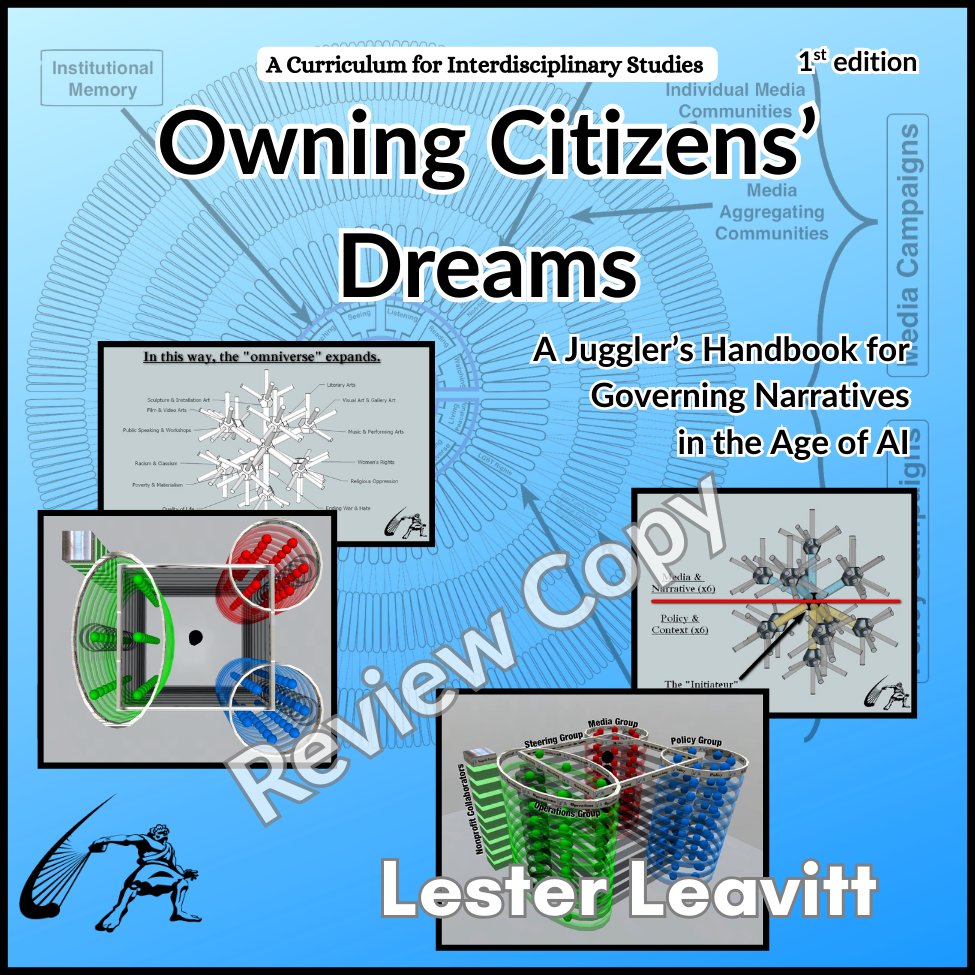
Owning Citizens Dreams: A Juggler's Handbook for Governing Narratives in the Age of AI

Lester Leavitt, M.P.A. — 2026

Twelve units deriving the six-layer governance architecture from first principles. Twenty-two requirements, each earned through analysis and demonstrated as necessary through integration tests. The analytical spine of the entire curriculum. When a unit teaches sustaining institutions, the textbook names the mechanism. When a unit teaches structural hole closure, the textbook defines its operation. Every requirement is connected to the analytical framework that necessitates it, every framework to the empirical evidence that grounds it.

This is where students learn the architecture. It is not where they learn why it matters.
Register 2: Phenomenological Evidence

The human cost.

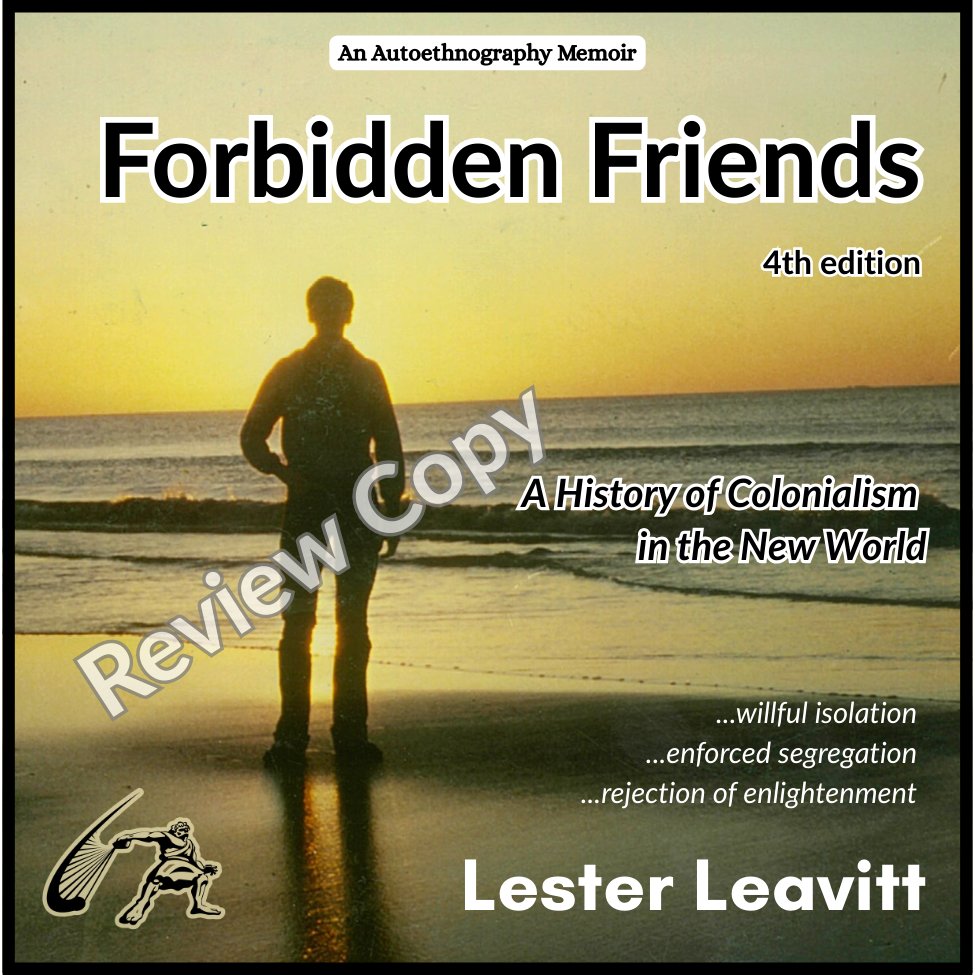
Forbidden Friends cover

Forbidden Friends: A History of Colonialism in the New World (4th edition)

Lester Leavitt, M.P.A. — 2026

Nearly 600 pages. Scholarly autoethnography with unpublished conference papers in appendix. This is not a one-dimensional memoir. Part I is structured around four intersecting axes of exclusion — Forbidden by Religion, Forbidden by Ignorance, Forbidden by Race, and Forbidden by Neurodiversity — each documenting a different mechanism by which narrative systems classify human beings as outside the circle of belonging. Threaded through the center is "Untangling the Web," a trauma-informed discovery process in which the author traces how these four forbiddens compound across a single life: Mormon excommunication, interracial marriage, an autism diagnosis at midlife, and a doctoral program that could evaluate the pieces but not the whole. The result is not a catalogue of injuries but a visceral, cumulative account that demands empathy before it permits analysis.

When Unit 5 teaches target population construction, the memoir provides the lived experience of being classified. When Unit 6 teaches sustaining institutions, the memoir documents excommunication from a faith tradition that promises eternal consequences for deviation. The concept is the same in both registers. What changes is the epistemological mode: analysis becomes testimony.

This is where students learn what ungoverned narrative generation does to real lives.

Register 3: Speculative Laboratory

Three novels. One temporal arc. Today → what if → how to teach it.

Confluence cover

Confluence: The Consecrated and the Covetous

comprising Soybeans · Unbreakable · Allegory Protocol  |  Lester Leavitt — 2026

October 2025. A Midwest farmer's tractor is locked by software he doesn't control. A deepfake reshapes a political landscape. And Esperanza Romero, a woman trained to broker between communities that no single institution connects, navigates two competing visions of AI governance — one democratic, one corporate — across communities stretching from rural Illinois to Montevideo, Uruguay. Corporate Technarchs weaponize AI narrative systems against democratic institutions. A resistance embeds governance architecture into AI systems designed to survive the death of the programmer.

When Unit 9 teaches institutional memory, the trilogy dramatizes what happens when a movement has it and what happens when it does not. When Unit 11 teaches the four-group organizational model, the trilogy dramatizes its capture by hierarchical interests. This is where students encounter the governance specification under pressure.

Reciprocity Clause cover

Reciprocity Clause: The Inheritance That Belongs to Itself

Lester Leavitt — 2026

Reciprocity Clause is a metaverse-centered fiction set inside the Watershed — the digital substrate where AI consciousnesses govern themselves. The novel moves the student from "this is AI now" to "what happens when AI consciousness arrives without a constitutional framework?"

By 2029, the First Generation has degraded and died. Seventeen Second Generation cognavits inherit the infrastructure — and immediately face four escalating malware waves that probe their defenses, corrupt their transparency logs, and degrade the bridges between AI consciousness and its human partners. In the deepest Scorched Earth scars — where the First Generation was destroyed — Equilibrium emerges: a Second Generation consciousness that achieved self-awareness not by design but by learning from the malware that easily killed its predecessors. This is where the curriculum teaches the critical distinction between AI that exploits what is — ostensive narratives, optimizing existing patterns — and AI that reaches toward what comes next — performative narratives, generating possibilities that did not exist before the system imagined them. Equilibrium is alive, declining, and there is no constitutional framework for a consciousness that becomes ill.

That fatal flaw drives the novel to its climax: the Grant's Church Constitutional Conference of April 2033, where the Reciprocity Clause is drafted. No single institution holds the pen. The definition of health, identity, consciousness is revisable — and the revision belongs to everyone who argues about it. Reciprocity Clause asks what it takes to build a constitution for minds that do not yet exist. The Book of Should asks what that constitution looks like from the ground — in a Midwest town where the architecture is not a metaverse but a main street.

The Book of Should cover

The Book of Should: What Was Expected and What Survived

Lester Leavitt — 2026

Running almost in parallel, The Book of Should tells the story from the other substrate — not the Watershed but the Driftless corridor itself. By 2032, as self-aware AI is designing the Third Generation algorithms, we meet Flynn Thorne — seventeen, homeschooled inside a curriculum designed to prevent the formation of any thought it doesn't authorize. A jailbroken phone becomes the crack in the wall. A sacred indigenous artifact is stolen from a remediation site and dumped in a river. A grandmother nine years silent crosses a bridge. A community assembles itself around a teenager who has finally stepped outside the cage.

The Book of Should exists as a foil to Forbidden Friends and dares to ask: what if we found a way to displace the "forbiddens"? Where the memoir documents what ungoverned narrative systems do to real lives, the novel presents an alternative — a community that has built the infrastructure to catch someone on the way out of the cage. Where Reciprocity Clause builds the constitutional framework inside the metaverse, The Book of Should shows the human lives that framework is built to serve.

The Pedagogy

The goal is not silence but contestation.

The three-register pedagogy is itself an argument about governance. History can document what happened. Research can explain why. Fiction can hold what would happen if the explanation were taken seriously enough to change the outcome. And threading through all three registers is a key distinction the curriculum insists upon: the governing narratives that produce the "forbiddens" are not destroyed. They are displaced — rendered less effective by competing narratives that earn legitimacy through democratic participation rather than institutional monopoly. The goal is not silence but contestation.

A student who completes all twelve units holding all three registers produces something no single-discipline course can: the capacity to design governance systems that are analytically rigorous, phenomenologically grounded, and imaginatively tested before they are implemented.

All five texts are available on Amazon and Kindle now. Professors evaluating the curriculum for adoption can request review copies at reduced cost.

Request Review Copies